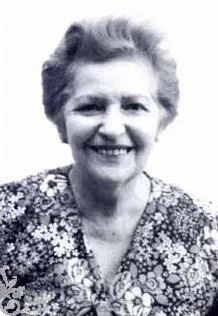
Grete Mostny, born on September 17th, 1914 in Linz/Upper Austria (residency for ("heimatberechtigt") Linz/Upper Austria), daughter of Paul Mostny (manufacturer in Linz, Rainerstrasse 27, died on May 23rd, 1929), was enrolled finally in spring term 1937 at the Philosophical School of the University of Vienna.
After she had graduated from high school ("Maedchen-Realgymnasium") in Linz on June 24th, 1933, she was enrolled at the Philosophical School of the University of Vienna from fall term 1933/34 until spring term 1937. During her studies she first lived in Vienna 5th district, Margaretenstrasse 71, and from 1935 in Vienna 7th district, Museumstrasse 7. She took courses in Egyptology, African Studies and Languages and Prehistory and was a member of the exclusive Egyptologist "Totenbuch"-circle at the salon of Marianne von Werther, together with the professors and lecturers of the Egyptology Department. She had already finished her dissertation "Die Kleidung der aegyptischen Frau im alten Reich" (Dresses of Egyptian women in the Old Kingdom), which was successfully approbated by both doctoral advisors, Wilhelm Czermak (Egyptologist) and Camillo Praschniker (Classical Archeologist) on December 10th, 1937. On December 18th, 1937 she also passed the 2 hours long second final examination ('Rigorosum') with her doctoral advisors and Viktor Christian (Orientalist). She applied for last step, the first Rigorosum but before she could fix the examination date, the Nazi rise to power ("Anschluss") made it impossible to finish her studies and she had to leave the University of Vienna with a approbated dissertation but without an academic degree.
She finished her studies at the Free University in Brussels/Belgium and gained a doctoral degree in Oriental Philology and History in 1939. She also took the opportunity to take part in archeological excavations in Luxor and Cairo/Egypt and with the help of a Chilean friend in Linz she could finally emigrate to Chile, together with her mother and her brother Kurt, four years younger. They arrived in Valparaíso in 1939. In the same year she started in the National Museum for Natural History (MNHM|Museo Nacional de Historia Natural ) as an "ayudante de la sección de Antropología" and became head of the anthropological department in 1943 (until 1964). In the museum she was always called "Doctora". In this time she was also visiting scholar in Milan/Italy, Egypt and Paris/France. In 1949 she received a honorary doctorate of the University of Cuzco.
After the end of WWII Austrian government sent her the doctoral diploma of the Vienna University and asked her to return to Austria and to work at Vienna University. She refused the job-offer and became naturalized as Chilean citizen in 1946. In the same year she had started an archeological excavation on Chilean aborigines together with Prof. Alejandro Lipschutz in Tierra del Fuego. She was head of several other archeological excavations (e.g. in Quiani, La Lisera, San Miguel de Azapa, Punta Pichalo, Pisagua, Chiu-Chiu, Peine, Toconce, Río Loa Superior, Salar de San Martín, Guatacondo, Antofagasta, Ovalle and La Serena y Combarbalá). She continued her research on ancient cultures in the territory of Chile. She took part in the "Segundo Congreso Interamericano Indigenista" and became professor at the Facultad de Filosofía y Educación at Universidad de Chile and lectured in cultural anthropology of American and Chilean prehistory. 1954 she was involved in the discovery of the famous Inca child mummy of Cerro el Plomo, a height of her archeological career. 1959 she was involved in the foundation of the "Asociación de Museos Chilenos (later: "Comité Chileno de Museos").
She survived her first husband, Fischel Wassner (owner of a sombrero factory) and Juan Gómez Millas became her second husband, former rector of the Universidad de Chile (1953-1963) and state secretary for Education (1953, 1964-1968). She became director of the National Museum for Natural History in 1964 (until 1982).
She passed away on December 15th, 1991 in Chile because of cancer.
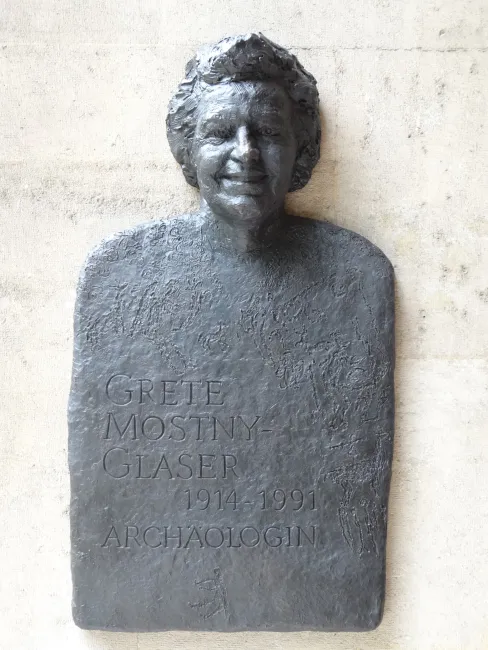
Since 2009 there is a meorial site for Grete Mostny in the "Memorial Book for the Victims of National-socialism at the University of Vienna 1938". In 2013 the Faculty of Historical and Cultural Studies of the University of Vienna awards the "Grete Mostny-Dissertationspreis" for outstanding doctoral thesis'. On 30 June 2016 a memorial of Grete Mostny was unveiled in the arcaded courtyard of the University of Vienna (artist: Karin Frank)