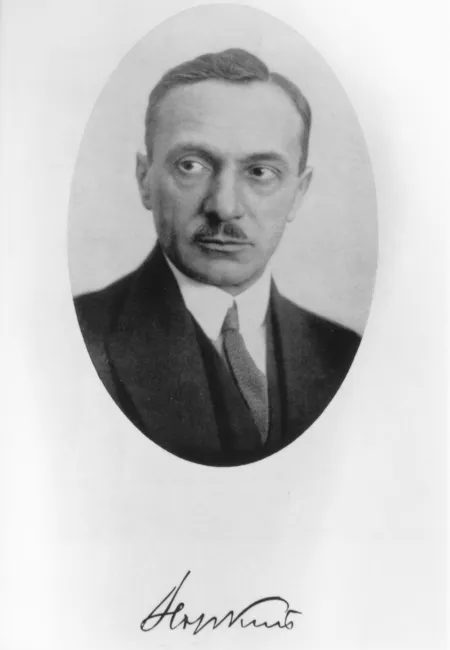
Guido Holzknecht was the son of a Viennese family of civil servants. He attended the grammar school of the Benedictine monastery in Seitenstetten/Lower Austria and, after passing his school-leaving examination, studied medicine at the universities of Strasbourg, Königsberg and Vienna, where he was awarded a doctorate in medicine in 1899. As a student, he witnessed the discovery of X-rays, as one of his teachers was closely associated with Conrad Röntgen (1845-1932). Even before completing his doctorate, he gave a demonstration to the Society of Physicians in Vienna; he then published his findings there as his first scientific paper.
After completing his doctorate, Holzknecht worked at Hermann Nothnagel's clinic. In order to support his assistant Holzknecht's interest in the young X-ray technology, Nothnagel had a vacant machine installed at his clinic. He soon set up his own X-ray station under his management. In 1901, he was able to publish a textbook on the X-ray examination of breast tissue, a work that opened up new territory and established his worldwide fame as a radiologist. In 1904, he was awarded the venia legendi for medical radiology, and a year later Holzknecht was appointed director of the newly established Central Radiology Institute at the General Hospital. Under his leadership, this institution developed into a training center for radiologists from all over the world, making Holzknecht the founder of his own school of radiology in Vienna.
He is considered a pioneer of radiological research and worked practically and scientifically in all relevant fields, including the technology and effects of X-rays for the treatment of malignant tumors. His oeuvre comprises around two hundred scientific papers. He also founded the Handbuch der theoretischen und klinischen Röntgenkunde (1929). Holzknecht was an honorary member of numerous scientific societies, was appointed associate professor and primary physician at the General Hospital in 1914 and was awarded the title of Hofrat in 1928. At an early age, Guido Holzknecht had contracted a long-term illness due to radiation damage, to which he succumbed after several operations as a victim of his profession.
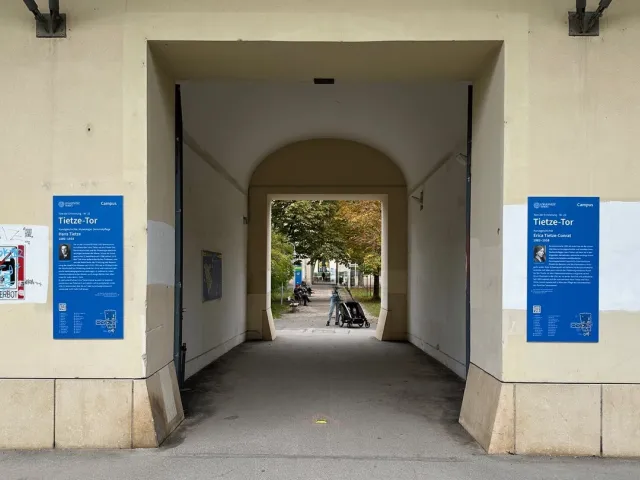
He was honored in 1998 by the naming of one of the "Gates of Remembrance" on the campus of the University of Vienna after him (Holzknecht Gate, passageway from Hof 7 to Rotenhausgasse).
Daniela Angetter, Birgit Nemec, Herbert Posch, Christiane Druml, Paul Weindling, Strukturen Und Netzwerke. Medizin Und Wissenschaft in Wien 1848–1955. 650 Jahre Universität Wien – Aufbruch Ins Neue Jahrhundert. Vol. 5 (Göttingen 2018), doi:10.14220/9783737009164.