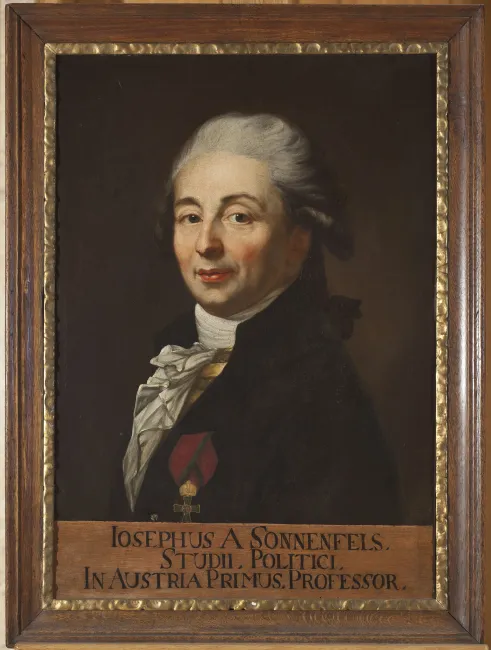
Sonnenfels, Josef von

Univ.-Prof. Dr. art. lib., Dr. phil., Dr. jur.

1733–25.04.1817

Born in Nikolsburg | Mikulov, Czechia
Died in Vienna, Austria

Josef von Sonnenfels (1733–1817), Rektor 1792/93, 1795/96

(Iosephus de Sonnenfels)

Imperial Directorial Court Councillor, Professor of Political Science

Honor Title Faculty Date
Room Name Joseph-von-Sonnenfels-Zimmer Faculty of Law 2020
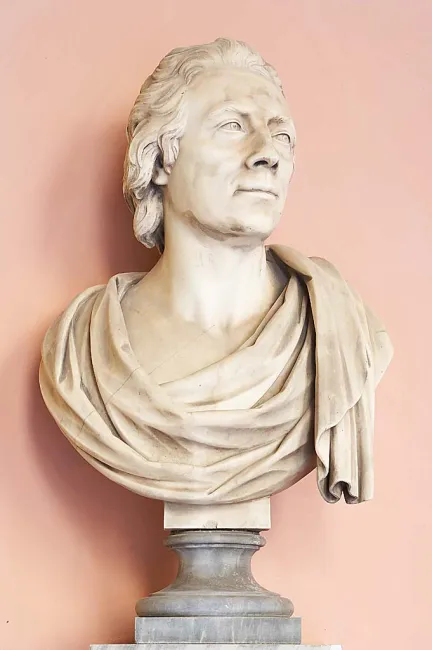
Monument in arcaded court Faculty of Law and State 1891

Büste von Alois Düll, finanziert vom k k. Ministerium fiir Kultus und Unterricht, 1891 aufgestellt.

siehe auch u: monuments: Denkmal Josef von Sonnenfels

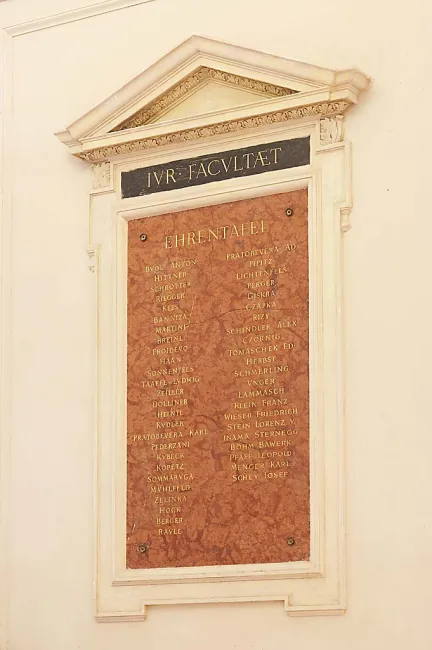
Commemorative Plaque of Faculty Faculty of Law and State 1893

Die Ehrentafeln der Fakultäten in den Seitenaulen des Hauptgebäudes der Universität Wien wurden am 24. Mai 1893 enthüllt. Zu diesem Zeitpunkt umfasste die Ehrentafel der Rechts- und Staatswissenschaftlichen Fakultät eine Liste von 37 Namen von berühmten Schülern der Universität Wien, darunter jenen von Josef von Sonnenfels. Die Liste war für die Fakultät von Prof. Leopold Pfaff bzw. im Auftrag des Senats von Universitätsarchivar Karl Schrauf zusammengestellt worden.

The honorary plaques of the faculties in the side columns of the main building of the University of Vienna were unveiled on May 24, 1893. At that time, the honorary plaque of the Faculty of Law and Political Science included a list of 37 names of famous students of the University of Vienna, including that of Josef von Sonnenfels. The list had been compiled for the faculty by Prof. Leopold Pfaff and by university archivist Karl Schrauf on behalf of the Senate.

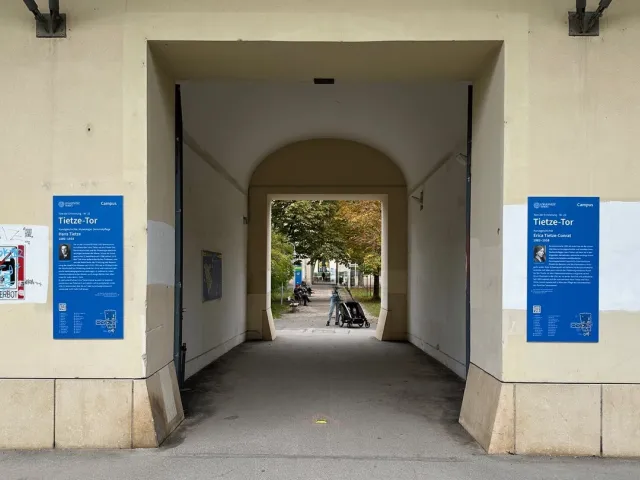
Gate of Remembrance Sonnenfels-Tor 1998/99

Funktion Zeitraum Fakultät
Rector 1793/94
Rector 1795/96
Josef von Sonnenfels (1733–1817), Rektor 1792/93, 1795/96
Josef von Sonnenfels (1733–1817), rector 1792/93, 1795/96
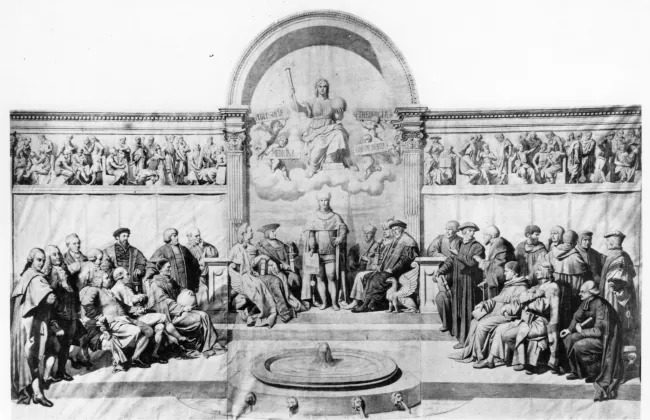
Allegorie zur Fünfhundertjahrfeier 1865: Die Förderer und berühmtesten Lehrer der Universität Wien
Allegory for the quincentenary 1865: The patrons and most famous teachers of the University of Vienna
Denkmal für Josef von Sonnenfels (1733–1817) im Arkadenhof der Universität Wien, gestaltet von Alois Düll, enthüllt 1891
Monument to Josef von Sonnenfels (1733–1817) in the Arkadenhof (arcaded court yard) of the University of Vienna, sculptured by Alois Düll, unveiled 1891
Ehrentafel der Rechts- und Staatswissenschaftlichen Fakultät, Aula der Universität Wien
Commemorative Plaque of the Faculty of Law in the entrance hall (Aula) of the University of Vienna

Political Sciences

Josef von Sonnenfels came from a Jewish family who immigrated to South Moravia from Berlin and converted to the Catholic faith here. He first graduated from the Piarist College in his birthplace Nikolsburg (Mikulov) and then from the Faculty of Philosophy at the University of Vienna (1745–49). After serving in the military for five years, he began studying law in Vienna. His preferred teachers were the canonist Paul Josef Riegger and the professor of natural law Karl Anton von Martini.

In 1763, Josef von Sonnenfels was awarded the newly created professorship for police and cameral science (political science), which was initially based at the Faculty of Philosophy and from 1784 at the Faculty of Law. Sonnenfels understood „police science“ to mean the principles of „establishing and managing internal security ...“ Thus, police science encompassed „numerous areas of the state, such as questions of security, population growth, welfare, education, training, social issues“ etc. In addition, he worked for many years as a law teacher at the Theresian and Savoy Knight's Academies as well as in numerous other secondary offices, including as a theater censor and advisor to the Censorship Court Commission (1770–72), member of the Lower Austrian government (from 1773) and also as a member of the Study Court Commission (1780). In 1781, Emperor Joseph II entrusted him with the „doctrine of business style“ in addition to cameral science, with the simultaneous task of enacting all additional laws.

As a „state stylist“, Sonnenfels also had an influence on the content of legislation and made a lasting contribution to the intellectual shaping of the Austrian bureaucracy with his work „On Business Style“.

He was a member and advisor to numerous commissions. He was twice elected Rector of the University of Vienna (1794, 1796), and from 1811 he was President of the Academy of Fine Arts. Sonnenfels had a lasting impact through his legal and economic policy teachings, through which he influenced generations of Austrian lawyers in the spirit of Austrian national education and in the Josephinian spirit. From 1765 to 1848, his book „Grundsätze der Polizey, Handlung und Finanz“ (Principles of Police, Action and Finance) was regarded as the definitive text and lecture book at Austrian universities. In terms of state theory and philosophy, Sonnenfels stood on the basis of the natural law doctrine of state contracts, which he gave a strong utilitarian coloring. In doctrine and practice, he strove to improve the quality of law and comprehensive codifications, in which he himself was involved to varying degrees (Josefinisches Strafgesetz, Allgemeines bürgerliches Gesetzbuch). In the area of criminal law, for example, he achieved the extensive abolition of torture.

As a publicist and critic, he promoted the new German literature in his weekly newspaper „Der Mann ohne Vorurteil“ and campaigned for the renewal of Viennese theater in the spirit of Gottsched. Sonnenfels, who was also a leading freemason (lodge „Zur wahren Eintracht“) and illuminate, is generally regarded as an outstanding representative and disseminator of the Enlightenment in Austria.

He was honored in 1998 by the naming of one of the „Gates of Remembrance“ on the campus of the University of Vienna (Sonnenfels Gate, main entrance Alser Straße 4).

 

Authors

Kurt Mühlberger

Last updated

24.09.2026

Versioned citation link

https://geschichte-v2026.visuelles.xyz/en/node/29006/revisions/35699/view

Druckversion

Druckversion öffnen

Literature and printed sources

Felix Czeike, Historisches Lexikon Wien in 5 Bänden (Wien 2004).
Alfred Ebenbauer, Wolfgang Greisenegger, Kurt Mühlberger, Historie Und Geist. Universitätscampus Wien Band 1 (Wien 1998).
Universität Wien, Wienerischer Universitätsalmanach [Taschenbuch Der Wiener K.K. Universität | Wienerischer Universitäts-Schematismus]. 1791-1872 vol. (Wien 1791).
Kamila Staudigl-Ciechowicz, Von Sonnenfels Bis Kadečka – 200 Jahre österreichischer Strafrechtsentwicklung. In: Rechtsstadt Wien. Juristische Schulen, Rechtswissenschaftliche Lehre Und Forschung in Der Bundeshauptstadt, Verlag Der Provinz, edited by Gerhard Strejcek, – (Wien).