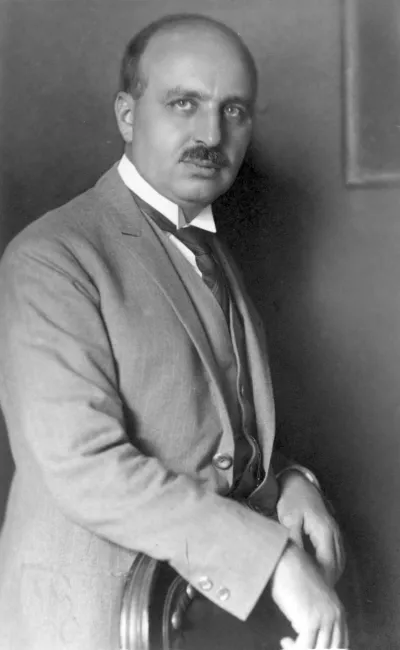
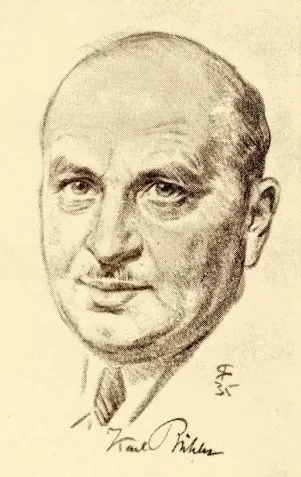
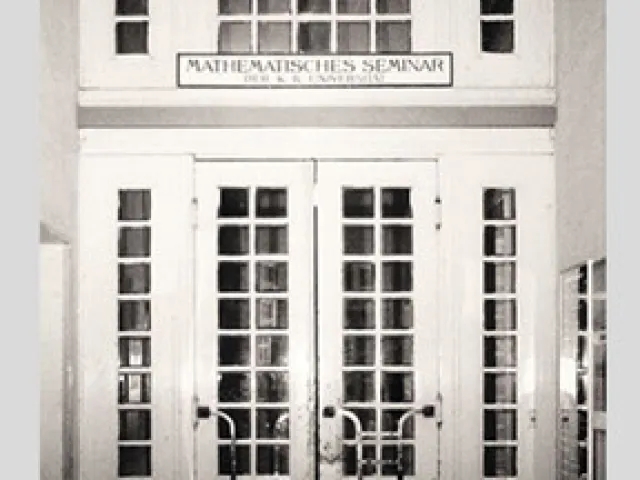
Karl Bühler received his doctorate in medicine from the University of Freiburg im Breisgau (1903) and pursued parallel studies in psychology and philosophy, which he continued in Strasbourg. He also obtained a doctorate in philosophy there in 1904. In the years that followed, he worked as an assistant and lecturer at the universities of Würzburg and Bonn, was a lecturer in Munich from 1913 to 1918 and was awarded a chair in psychology at the Dresden University of Technology in 1918. When all three chairs of philosophy at the University of Vienna were vacant, Karl Bühler was offered a professorship in 1921, which he accepted a year later. His professorship was specified as „full professorship of philosophy with special consideration of psychology and experimental pedagogy“. In collaboration with his wife Charlotte Bühler, he helped to establish the newly founded Institute of Psychology and a globally recognized school of psychology. Through his research - in the field of language and creativity - Bühler, alongside Sigmund Freud, made a decisive contribution to the development of psychology in the first half of the 20th century.
He was also active in the field of teacher training at the Pedagogical Academy of the City of Vienna and - together with his wife Charlotte - played a pioneering role in the establishment of empirical social research. He wrote groundbreaking scientific works in the fields of Gestalt and child psychology as well as language theory; the most important of these include „Die geistige Entwicklung des Kindes“ (1918), „Die Krise der Psychologie“ (1927), „Ausdruckstheorie“ (1933), „Sprachtheorie“ (1934), „Die Zukunft der Psychologie und die Schule“ (1936). His students and colleagues included Paul Lazarsfeld, Marie Jahoda and Karl Popper.
Immediately after the National Socialists came to power in 1938, Karl Bühler was arrested by the Gestapo and held in „protective custody“ for more than six weeks. His and his wife's only option was to emigrate. In 1940, he was granted American citizenship and became Professor of Psychology at St. Scholastica College in Duluth, Minnesota, and also taught at the College of St. Thomas, St. Paul, Minnesota. In 1945, he moved to the Medical School of the University of Southern California, Los Angeles, as Assistant Clinical Professor of Psychiatry and then became Consulting Psychologist at the Cedars of Lebanon Hospital in Los Angeles for two years. Although Karl Bühler succeeded in obtaining professorships in the USA, he was never able to come to terms with the mental separation from his former place of work.
Honors
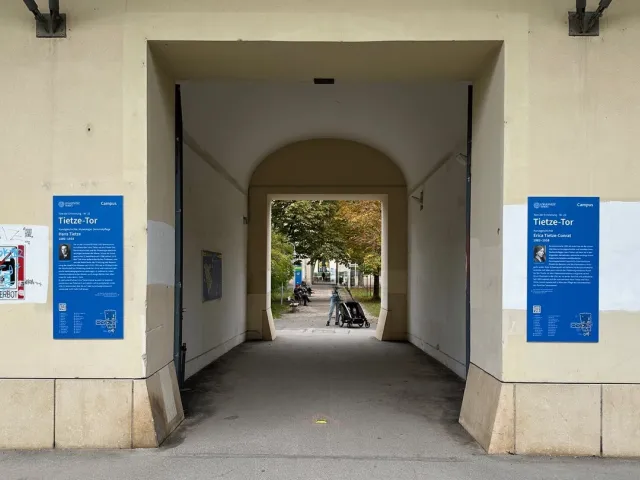
He was honored in 1998 by naming one of the „Gates of Remembrance„ on the campus of the University of Vienna after him and his wife (Bühler Gate, campus entrance from corner Spitalgasse/Alser Straße into court 1).
Janette Friedrich, Gerhard Benetka, 100 Jahre Psychologisches Institut Der Universität Wien - Die Lokale Komponente Wissenschaftlicher Forschung. Ein Arbeitsbuch. Buehleriana. Vol. 1 (2) (Lausanne 2026), online at https://karlbuehler.org/pub-257007.
Janette Friedrich, Karl Bühler Und Das Wiener Psychologische Institut : Dokumente Und Fundstücke. Bühleriana. Originalausgabe. Vol. 1 (Lausanne 2022), online at https://karlbuehler.org/pub-216558.
Janette Friedrich, Gerhard Benetka, Karl Bühler Und Das Wiener Psychologische Institut Oder Die Bedeutung Des Lokalen. Buehleriana. Vol. 2 (Lausanne 2022), online at https://karlbuehler.org/pub-216559.
Janette Friedrich, Karl Bühlers Krise Der Psychologie. Positionen, Bezüge Und Kontroversen Im Wien Der 1920er 30er Jahre. Veröffentlichungen Des Instituts Wiener Kreis (Berlin 2018).
Maria Czwik, Forschungen Zum Film Am Psychologischen Institut Der Universität Wien in Den 1930er Jahren. Versuch Einer Übersicht. In: Karl Bühlers Krise Der Psychologie. Positionen, Bezüge Und Kontroversen Im Wien Der 1920er 30er Jahre, edited by Janette Friedrich, 33-59 (Berlin 2018).
Hans-Joachim Dahms, Der Neubeginn Der Wiener Philosophie Im Jahre 1922. Die Berufungen Von Schlick, Bühler Und Reininger. In: Karl Bühlers Krise Der Psychologie. Positionen, Bezüge Und Kontroversen Im Wien Der 1920er 30er Jahre, edited by Janette Friedrich, Friedrich Stadler, 3-32 (Berlin 2018).
Johannes Feichtinger, Die Verletzte Autonomie. Wissenschaft Und Ihre Struktur in Wien 1848 Bis 1938. In: Universität – Forschung – Lehre. Themen Und Perspektiven Im Langen 20. Jahrhundert, edited by Katharina Kniefacz, Elisabeth Nemeth, Herbert Posch, Friedrich Stadler, 261-292 (Göttingen 2015), online at http://www.vr-elibrary.de/doi/pdf/10.14220/9783737002905.261.
Herbert Posch, Katharina Kniefacz, Friedrich Stadler, Online-Gedenkbuch Für Die Opfer Des Nationalsozialismus an Der Universität Wien 1938, Http: Gedenkbuch.univie.ac.At (2009), online at http://gedenkbuch.univie.ac.at/.
Achim Eschbach, Gabi Willenberg, Karl Bühler. In: Vertriebene Vernunft II. Emigration Und Exil österreichischer Wissenschaft 1930–1940, edited by Friedrich Stadler, 2nd ed., 297–305 (Münster).
Werner Röder, Herbert A. Strauss, Biographisches Handbuch Der Deutschsprachigen Emigration Nach 1933 | International Biographical Dictionary of Central European Emigres 1933–45 [4 Bände]. 4 vol. (München, New York, London).