The April 1938 issue of the church newspaper "Der Säemann" contains the succinct report that Karl Beth, the previous dean of the Protestant Theological Faculty, resigned from his deanship "of his own accord" on Wednesday, March 16. It is deliberately concealed that the almost 66-year-old was also expelled from his teaching post. The courses he had announced for the summer semester of 1938, including the compulsory lecture of the corporative state "On ideological education", were canceled without replacement. The racist reorganization of the Austrian civil service on 31 May 1938 also provided the legal basis for this. Beth was still able to take part in two doctoral procedures as an assessor, but otherwise he was no longer acceptable as an academic teacher who was married to a Jewish woman, the lawyer and orientalist Marianne Beth von Weisl (1890 1962). At the end of March 1939, he was deprived of his pension and subsequently emigrated to America, where he was lucky to be able to continue teaching in Chicago. "We did everything", according to a retrospective euphemistic memoir by his faculty colleague Gustav Entz (1884-1957), "to show our colleague that we regretted this action by the authorities". Nevertheless, three students found their way to his apartment on Spittelberg (VII, Zitterhofergasse 8) to express the gratitude of the student body shortly before his departure.
Who was this Karl Beth who, unlike his wife, was not included in the anthology "Vertriebene Vernunft: Emigration und Exil österreichischer Wissenschaft 1930-1940" (Vienna/Munich 1987)? Was he overlooked because he was a theologian or because his scientific achievements were not perceived as specifically Austrian due to his Prussian origins? After the Second World War, the Second Republic initially refused to pay Beth, who had remained in America, an Austrian civil servant's pension; this benefit first had to be fought for in court, although he had undoubtedly been an Austrian civil servant between 1906 and 1938. On the occasion of his 60th birthday, the Neue Freie Presse (12. 2. 1932) praised him as a theological researcher who was interested in the direct connection between his discipline and the intellectual currents of the present. In 1936 he was honored by the rector of the University of Vienna on the occasion of his 30th anniversary of service.
Born in Förderstedt in the province of Saxony in 1872 and raised in Stendal, where his father worked as a school principal, he devoted himself to studying philosophy and theology at the universities of Tübingen and Berlin after leaving grammar school.
Here he graduated as Licentiatus theologiae in 1897 and Doctor philosophiae in 1898, habilitating in systematic theology in 1901. Enjoying the "Schleiermacher travel grant", he then undertook a research trip to the eastern Mediterranean countries, the results of which can be seen in the work "Die orientalische Christenheit in den Mittelmeerländern" (Berlin 1902), which presented a more differentiated view of the Orthodox Church than that of his teacher Adolf von Harnack (1851-1930). It was even said of him that it was the first work by a Protestant theologian that was able to do justice to the Eastern Church in its particular character. However, Beth became famous for his research into the psychology of religion, in which he undertook physiological studies and drew on experimental psychology and biology to gain a clearer understanding of the spiritual phenomena of religion, but confronted this scientific approach to religion with the history of religion and philosophy. His study "Religion and Magic" with the explanatory subtitle that characterizes his method: "A contribution in the history of religion to the psychological foundation of the theory of religious principles" (2nd ed. 1927) marks this scientific endeavour.
In 1927, he founded the International Society for the Psychology of Religion, whose publication organ he edited in Vienna, where he had also headed his own research institute for the psychology of religion since 1922. In 1931, he organized a highly regarded international congress on the subject of the "Psychology of Unbelief". In 1932, he undertook a research trip to Abyssinia. Another facet of his work was his involvement in the beginnings of the ecumenical movement, for example he headed the Austrian branch of the World Federation for International Friendship of Churches after the First World War. Between 1939 and 1945, he taught philosophy and psychology of religion in Chicago.
He remained connected to his Viennese faculty throughout the years of emigration. And he testified to this heartfelt bond by sending food in the immediate post-war period, when students and teachers in Vienna were still often suffering from hunger. In a letter to Dean Wilhelm Kühnert (1900-80), his student, Beth also expressed his unquenched homesickness for the Viennese faculty. He never visited Vienna and died in Chicago on September 9, 1959.
However, the faculty named a research prize after Karl Beth in the 1980s, but it has not yet been awarded.
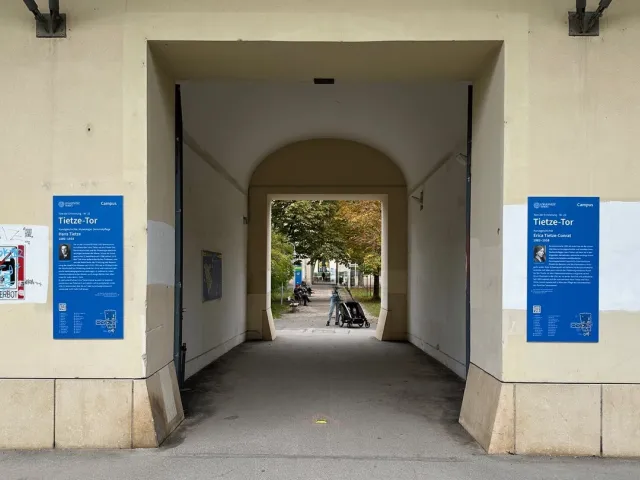
A 'Tor der Erinnerung (Gate of Remembrance)' on the campus of the University of Vienna has been named after him since 1998 (Beth-Tor, passageway between Spitalgasse - court 1)