
Gödel, Kurt
Born in
Brünn, Mähren, Czechia
Died in
Princeton,
New Jersey,
United States
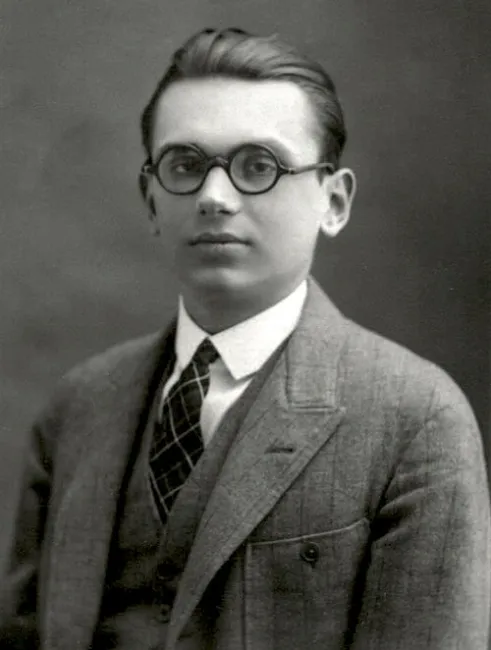
| Honor | Title | Faculty | Date | |
|---|---|---|---|---|
| Memorial Plaque of Honor Mathematics | Faculty of Mathematics | 2009 |
Show more
Die Ehrentafel wurde 1984 am Mathematischen Institut der Universität Wien enthüllt. Am 7. Oktober 2009 wurde der Name von Kurt Gödel der Ehrentafel hinzugefügt. The plaque of honour was unveiled at the Mathematical Institute of the University of Vienna in 1984. Kurt Gödel's name was added to the plaque on 7 October 2009. |
|
| Honorary Doctorate | Dr. rer. nat. h.c. | Faculty of Natural Sciences | 1977/78 | |
| Room Name | Kurt Gödel-Hörsaal (Physik) | Faculty of Physics | 21. Jhdt. |
gemeinfrei / public domain

Goedel, the son of a textile company director, attended secondary school in Brno and began studying physics at the University of Vienna in 1924. In the course of his studies, however, he devoted himself more and more to mathematics and mathematical logic. He obtained his doctorate in 1930 and began working at the department in that same year. During this time Goedel gained recognition through his study “Ueber formal unentscheidbare Saetze der Principia Mathematica und verwandte Systeme” (1931) as well as through his “incompleteness theorems”. In this he stated that “to prove the consistency of a system, more means are necessary than the system itself contains”. In his time in Vienna in the 1930s, Goedel’s most important works were published, which pre-eminently dealt with problems of logic. Around 1926 he also joined the Wiener Kreis. His interest here mostly focused on fundamental questions of mathematics as well as logic and the philosophy of science.
After the “Anschluss”, as of April 22nd, 1938, his teaching license was “suspended until further notice”, which prevented him from receiving any further teaching assignments at “Reich-German” universities. This disciplinary measure can be attributed first and foremost to the accusation of “always having moved in liberal-Jewish circles”. Furthermore, Hans Hahn - a Jew - had conducted Goedel’s habilitation. His close relationship with the Wiener Kreis was not mentioned in the political reports. Goedel felt forced to emigrate, and following an invitation from Princeton, he moved to the United States in 1938/39. When he still was in the USA in the summer semester of 1939, but according to the dean’s office had not requested a leave of absence, Dean Viktor Christian applied for a permanent revocation of Goedel’s teaching license. He however took back this application when Goedel requested to be appointed “Dozent neuer Ordnung” (lecturer under new regulation).
In his political assessment of Goedel, Arthur Marchet, head of the NS-Dozentenbund (National Socialist University Teachers’ League) at the University of Vienna, found no “remarks or activity against National Socialism” and summed up that in light of Goedel’s connections to “liberal-Jewish circles” he could neither endorse nor oppose the appointment to “Dozent neuer Ordnung” (lecturer under new regulation). Viktor Christian in turn found that Goedel had “hardly any inner relationship with National Socialism”. According to Christian, Goedel had grown up in a time “when Vienna’s mathematicians had been completely under Jewish influence”, but he seemed to be “a quite apolitical person”. In view of Goedel’s “fruitful teaching”, Christian endorsed the appointment. In the meantime, however, Goedel had already applied for exit to the United States, since he got the opportunity for further scientific work in Princeton. Christian stated that for lack of an adequately remunerated position in the German Reich he could not very well deny him his permission. The Reichserziehungsministerium (Reich Ministry of Education, REM) also gave him permission to exit the country on December 9th, 1939, as well as agreeing to make him “Dozent neuer Ordnung” (lecturer under new regulation) at the end of June 1940. This meant that further teaching positions at the University of Vienna remained a possibility for him.
Goedel would not return to Nazi-Germany, however. His brother, the x-ray specialist Rudolf Goedel, for example, informed the dean’s office in January 1941 that he would not return to Europe, “because the German consulate in New York had strongly advised him against it”. Subsequently, the Reichserziehungsministerium gave him another leave of absence. There is no mention of a revocation of his venia docendi in the files.
From 1939 to 1976 he was a member of the Institute for Advanced Studies in Princeton, where he received a teaching position in 1953. Two years earlier, Goedel - since 1948 an American citizen - having been suggested by Albert Einstein, had received the Albert Einstein award for calculations in the field of relativity theory. Neither the ministry of education nor the University of Vienna genuinely tried to convince him to return to Austria directly after the end of the war. In 1966 he then finally returned to the University of Vienna as an honorary professor.
Apart from his essential works on logic and basic mathematical research, Goedel also published in the fields of set theory, number theory, cosmology and on the foundations of relativity theory.
Among other things, he was awarded the National Medal of Science (1975). He also was a member of the National Academy of Sciences, the American Philosophical Society, the American Mathematical Society and the Association for Symbolic Logic. He received honorary doctorates from Yale and Harvard, from the Amherst College, as well as from the University of Vienna (1978). He declined an honorary membership from the Austrian Academy of Sciences in 1966.
On October 7th, 2009 his name was added to the honour plaque of the mathematical department of the University of Vienna.
Archiv der Universität Wien, Philosophische Fakultät, Personalakt 1757 und GZ 659-1937/38.
Authors
Andreas Huber
Last updated
24.09.2026
Versioned citation link
https://geschichte-v2026.visuelles.xyz/en/node/28483/revisions/30219/view