
Freud, Sigmund
Born in
Freiberg, Moravia | Příbor, Czechia
Died in
London,
United Kingdom

Neurologist, founder of psychoanalysis, influential thinker, cultural theorist
"Sigmund Freud's still controversial discovery of the unconscious is one of the most momentous concepts in the history of the human sciences - a concept that influenced philosophy and psychology as well as the arts, literature, cultural studies and modern brain research."
Konrad Paul Liessmann, Professor of Methods of Teaching Philosophy and Ethics at the University of Vienna
| Honor | Title | Faculty | Date | |
|---|---|---|---|---|
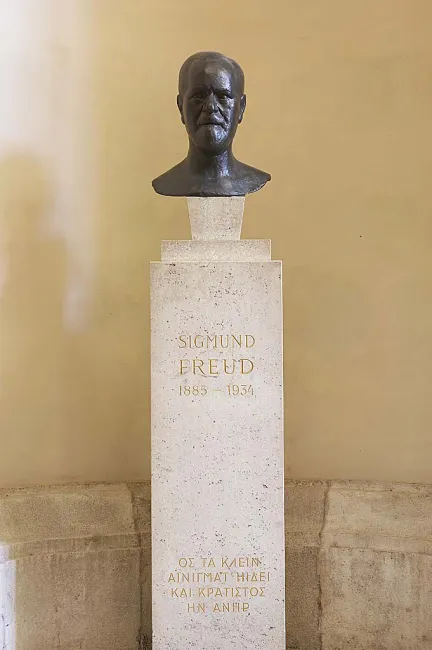
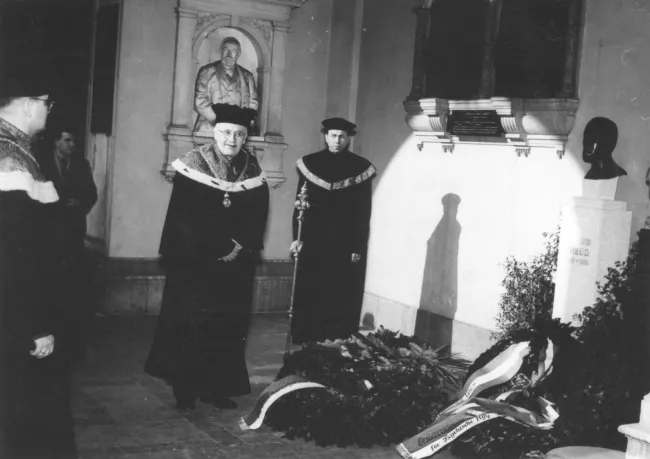
| Monument in arcaded court | Faculty of Medicine | 1955 |
Show more
Kopie einer Büste, welche 1920 im Auftrag des Freud-Schülers Max Eitingen (1881 bis 1943) von Paul Königsberger modelliert worden war. Anfertigung und Aufstellung wurden durch eine Spendensammlung, organisiert von Prof. Hans Hoff, finanziert. Das Denlmal wurde 1955 enthüllt. Das Original der Büste befindet sich im Freud Museum Wien. siehe auch u:monuments: Denkmal Sigmund Freud |
|
| Gate of Remembrance | Freud-Tor | 1998/99 |
CC0 (gemeinfrei / public domain)
Franz Pfluegl
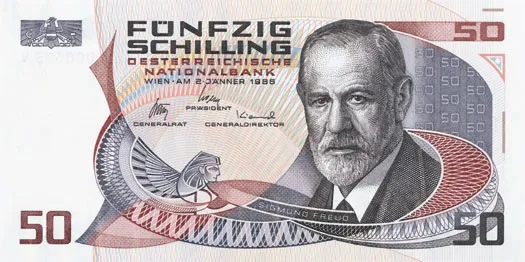
Österreichische Nationalbank
Sigmund Freud moved with his parents from Moravia to Vienna in 1859 and attended the Leopoldstadt grammar school. He studied at the University of Vienna and was awarded a doctorate in medicine in 1881. He soon began researching the nervous system and habilitated in neuropathology in 1885. After a research stay in Paris, he established himself as a doctor in Vienna.
He continued to work scientifically and increasingly turned to researching mental illnesses without organic findings. Through his theory of the development of neuroses, Freud arrived at fundamentally new views on the life of the soul and developed the science of unconscious mental processes. His teachings form the foundation of modern depth psychology. Freud developed the psychoanalytic therapy method (psychoanalysis), in which he also gained his insights into the drive structure of human behavior.
His most important works include "The Interpretation of Dreams" (1900/01), "Totem and Taboo" (1913), "The Ego and the Id" (1923) and "Civilization and Its Discontents" (1930). Freud's writings had an impact far beyond the confines of his specialist field and had a lasting effect on ideas about people and their behavior. His teachings were highly controversial among his contemporaries, particularly because of the central importance he attached to the sexual drive, with anti-Semitic resentment also playing a major role.
Although he did not receive his own chair at the University of Vienna - he was awarded the title of associate professor in 1902 and full professor in 1919 - he was able to gather a circle of students around him ("Wednesday Evening Society") and establish psychoanalysis worldwide. His teaching license at the University of Vienna expired in 1934.
Already seriously ill, he was forced to emigrate to England by the National Socialists in 1938.
He was honored at the University of Vienna in 1955 with a monument in the arcaded courtyard in the main bulding and in 1998 by naming one of the "Gates of Remembrance" on the campus of the University of Vienna after him and his daughter Anna Freud (Freud Gate, Spitalgasse).
Authors
Thomas Maisel
Last updated
24.09.2026
Versioned citation link
https://geschichte-v2026.visuelles.xyz/en/node/28458/revisions/34345/view