
Celtis, Konrad
Born in
Wipfeld, Germany
Died in
Wien,
Austria
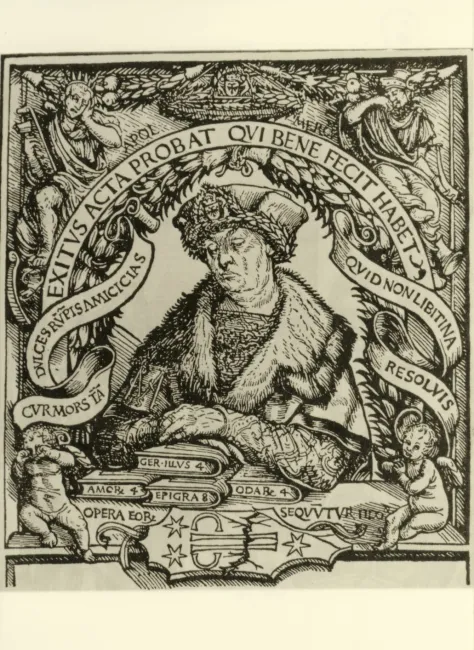
(Konrad Pickel or Bickel)
Konrad Pickel or Bickel was born in 1459 as the son of a winegrower in Wipfeld (Mainfranken).
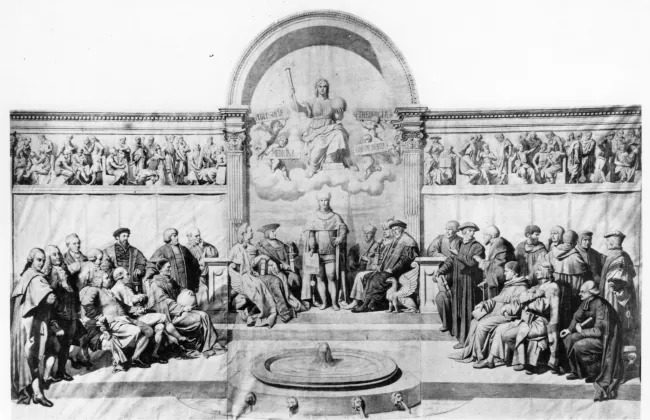
He later called himself Conradus Celtis Protucius in the manner of a humanist. Emperor Frederick III crowned him the first German poet in 1487. Maximilian I appointed him to the University of Vienna in 1497. As part of the Collegium poetarum et mathematicorum (1501) founded for him at the University of Vienna, Celtis was a key organizer and central figure in the humanist educational movement.
The immensely talented Franconian vintner's son studied artes and theology in Cologne (bachelor's degree in 1479) and especially rhetoric and poetics in Heidelberg, where he was awarded a doctorate as a student of Rudolf Agricola in 1485. Celtis taught poetics at the universities of Erfurt, Rostock and Leipzig in 1486/87. Emperor Frederick III crowned him with the poet laurel at Nuremberg Castle in 1487. He then undertook extensive study trips, which took him to Padua, Ferrara, Bologna, Florence, Venice and Rome, where he was in close contact with Italian humanists (Marsilius Ficinus, Philipus Beroaldus, Pomponius Laetus) and deepened his philosophical and literary knowledge. In 1489, Celtis went to Krakow via Croatia and Hungary, where he pursued astronomical and mathematical studies. Via Prague and Nuremberg, Celtis arrived in Ingolstadt in 1492, where he took up an extraordinary professorship at the university. Maximilian I appointed Celtis to a professorship of rhetoric and poetics at the University of Vienna in 1497, which he held until his death.
Integrating the self-confident "arch-poet" into the still scholastically oriented faculty of arts proved to be problematic. In 1501, the ruler therefore founded the Collegium poetarum et mathematicorum ("College of Poets and Mathematicians") as part of the university and entrusted him with the management of this institute and the right to award graduates with the laurel of the poet. This created a breeding ground for Renaissance humanism in Vienna with an emphasis on philosophical-historical as well as mathematical-scientific subjects. In many Central European cities, Celtis made friends with like-minded people, whom he bound together in a network of learned societies. In Vienna, he founded the "Danube Society", to which outstanding humanists such as Johannes Cuspinian, Andreas Stiboriu, Johannes Stabius, Hieronymus Balbus etc. belonged. Celtis is considered the most important German humanist and neo-Latin poet of the pre-Reformation period, whose work consists of writings on literary and educational theory, editions, a city description (Nuremberg), two dramas and a rich poetic oeuvre (elegies, odes, epigrams). Added to this is the correspondence he initiated. His aim was to revive Roman eloquence, ancient culture and science, to revive the cultural achievements of his own national past and to create his own works in the fields of science and art, which were to be based on the ancient model or even surpass it.
His numerous works and creations included a poetics ("Ars versificandi"), a treatise on rhetoric, memory and letter writing, a Greek grammar, editions of two tragedies by Seneca and Tacitus' "Germania", as well as the opera by Hroswitha von Gandersheim and the "Ligurinus" (an epic in hexameters about the first years of Emperor Frederick 1's reign and his battles with the Lombards), which he rediscovered. and his battles with the Lombard cities and Milan, the "urbs ligurina"). Of his own poems, the "Amores", elegies of an autobiographical nature, were published. His dramas "Ludus Dianae" and "Rhapsodia" introduced musical theater north of the Alps. In the course of his source research, he also discovered the famous Tabula Peutingeriana, the road map of the Roman Empire.
He was honored in 1998 by the naming of one of the "Gates of Remembrance" on the campus of the University of Vienna (Celtis Gate, passageway between courtyard 4 and courtyard 5).
Authors
Kurt Mühlberger, Thomas Maisel
Last updated
24.09.2026
Versioned citation link
https://geschichte-v2026.visuelles.xyz/en/node/28368/revisions/33511/view